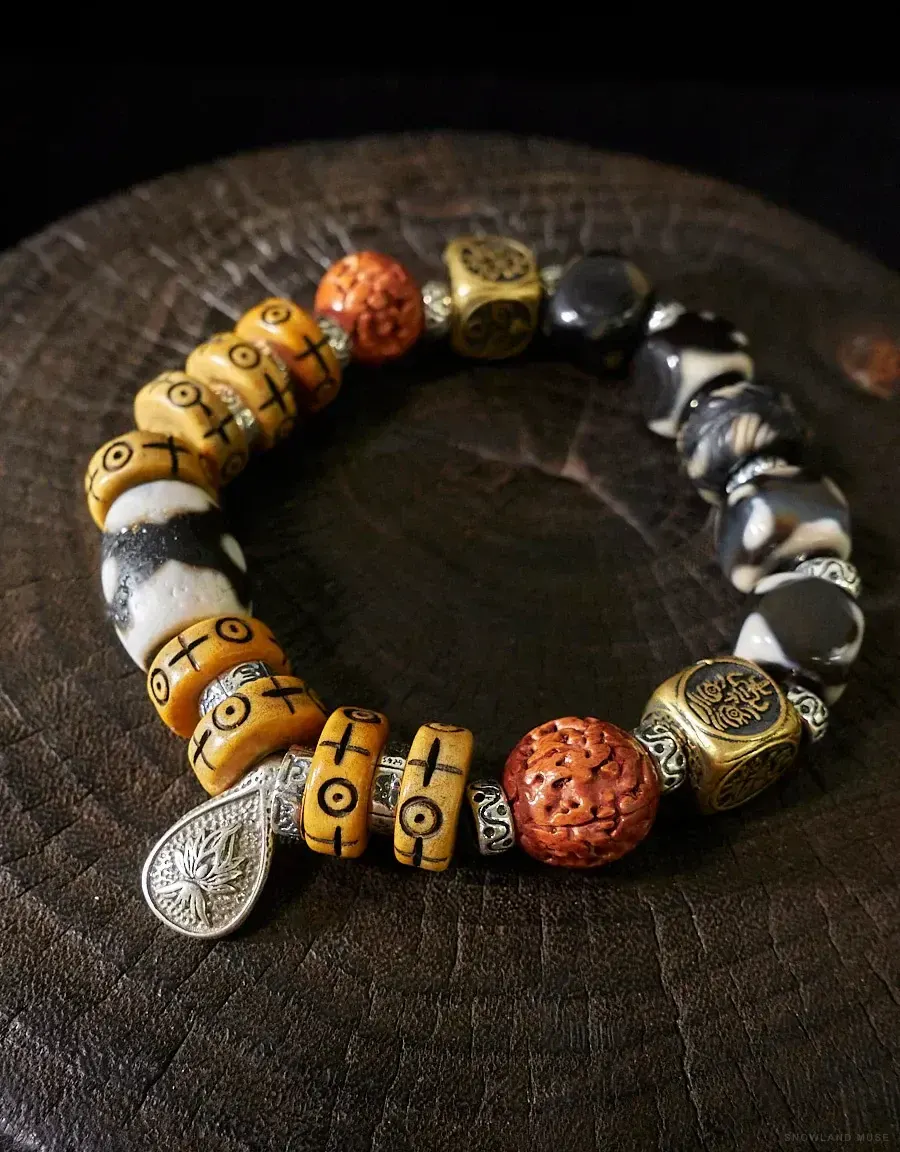
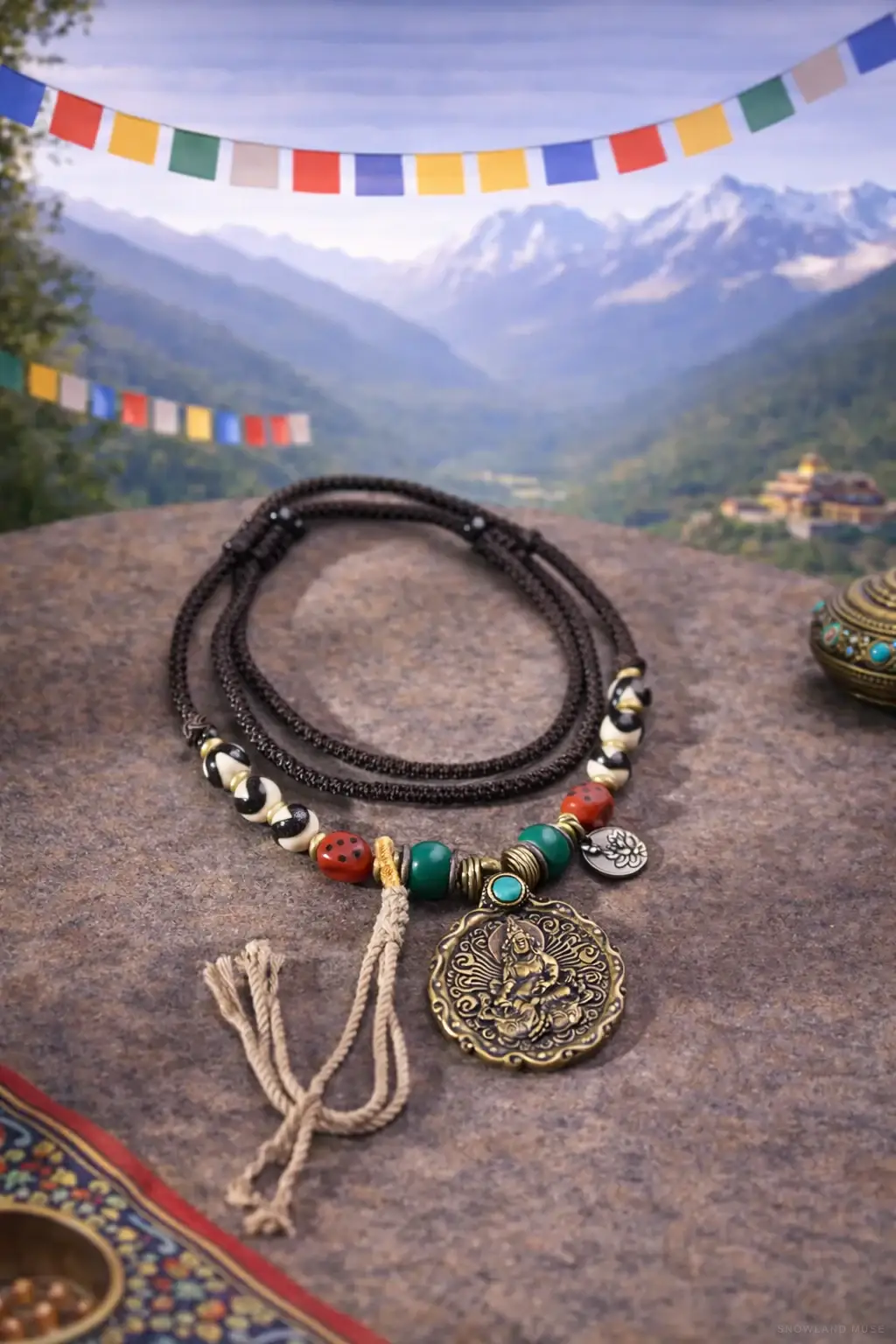
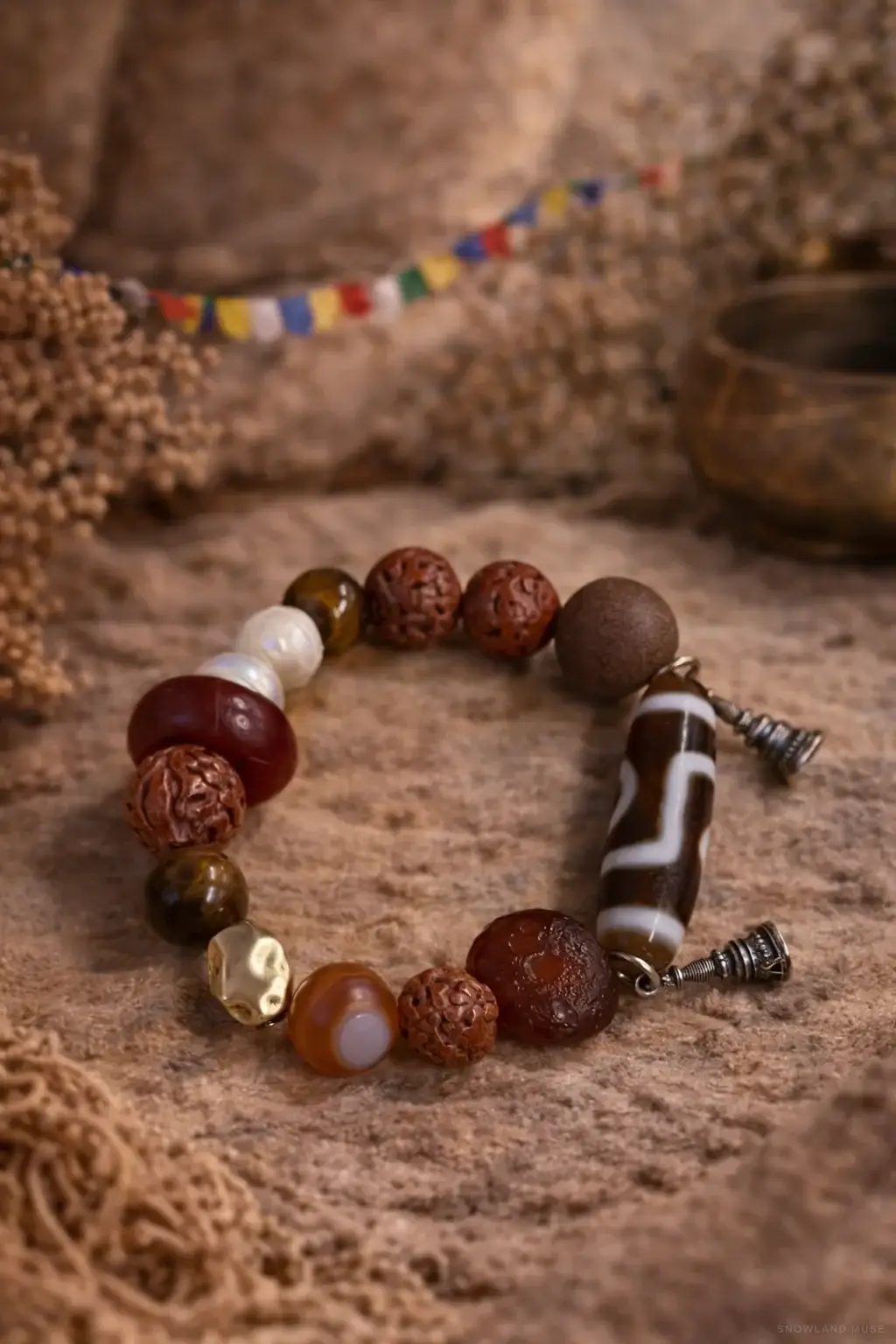
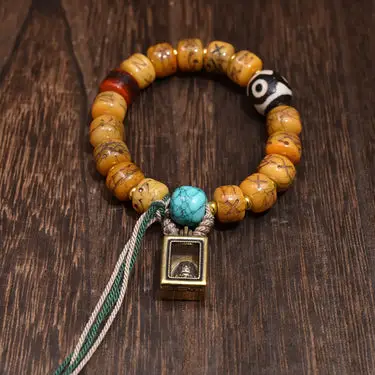
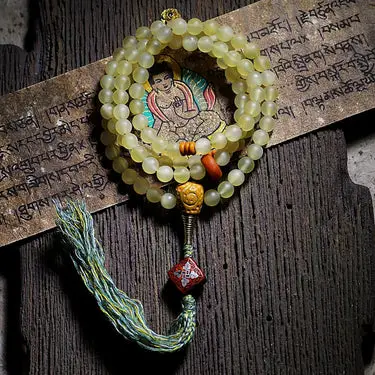
Cinnabar gives the design its starting point: a deep red material with a dense, almost matte surface. And where the first is quiet, the agate is a banded, gently translucent stone whose layers catch light at the polished surface. As a shape it is a strand that sits at the wrist. It belongs to the Dzi-style bead series, where the bead pattern leads the design and the companion materials support it. A mantra line is inscribed across the surface, following a Tibetan-language formula and reproduced as a design element. It is presented as cultural context rather than as a ritual service or a charged object. The mandala appears as concentric geometric rings. That geometry is shared across several traditions and is applied here as a radial structure for the design. The Dzi-style motif appears as eye, stripe and wave patterns worked into the agate itself. These patterns belong to the dzi bead tradition, and the label describes the bead design only — not the age, origin or history of the piece.
Each component is listed with the way it behaves, so nothing about the ageing comes as a surprise. Cinnabar needs a separate note: the colour is even and strong, and the surface is firm but dislikes abrasion. The agate is a banded stone that stays faintly translucent, so each layer picks up light differently. Against the skin, it takes daily knocks without dulling, though a thin edge can still chip against stone or metal. Inside the piece, the Dzi-style bead is an agate bead whose eye and stripe patterns sit in contrasting bands across the stone. Handled often, because the pattern is inside the stone rather than applied, it does not wear off with handling. The sterling silver appears as a bright white metal with a cool tone and a high polish. Over months of wear, it is a softer metal than steel and will take small scratches; the surface also tarnishes to a darker tone over time. Silver-Tone Metal — a bright cool-toned metal finish, plated rather than solid silver. In everyday use, the finish holds up well day to day, though a plated layer thins gradually where it rubs. The copper is a warm reddish metal with a soft, low-glare surface. Worn against fabric, it darkens toward a brown patina with wear and skin contact, which some owners prefer and others polish back. Inside the piece, the yak bone is an ivory-toned organic material, matte and slightly porous, with natural grain marks. With regular wear, it is light, warm to the touch and slightly absorbent, so it ages fastest where it meets skin. The bone appears as a pale, matte organic material with visible grain and a slight tonal difference between beads. Worn regularly, it is light in the hand and warm to the touch, but softer than stone and it dislikes knocks.
Sizing runs across three stated ranges: 6.75–8 in, up to 9.5–10.5 in. If you are between two options, the smaller one usually sits better on a piece that carries weight. What the motif carries is symbolic, and the meaning it takes on is the wearer’s to decide. Slight differences in shade, inclusion and grain between pieces are inherent to the materials. Nothing is charged until the exact piece and its measurements have been confirmed with you in writing.
Care
Avoid water, heat and household chemicals, and store the piece separately to prevent scuffing. Wipe it with a soft dry cloth and store it separately so the polish is not scratched by other jewellery. Care for it as you would a polished agate: keep it away from chemicals and impact, and wipe it dry after wear. Keep it dry, store it in a low-air space, and use a non-abrasive silver cloth when you want the original brightness back. Keep it away from water, perfume and abrasive cloths so the finish lasts longer. Wipe it dry after wear and store it away from damp air; polish only with a copper-safe cloth if you want the original brightness. Keep it dry, out of prolonged sun, and never soak it. Keep it dry, out of prolonged sun, and wipe it gently; ask before using any cleaner. Put it on last and take it off first, and keep it in its own pouch between wears.
A note on meaning
Symbols and materials may support reflection, memory or ritual. They are not medical treatment and do not guarantee wealth, protection, healing or any spiritual result.