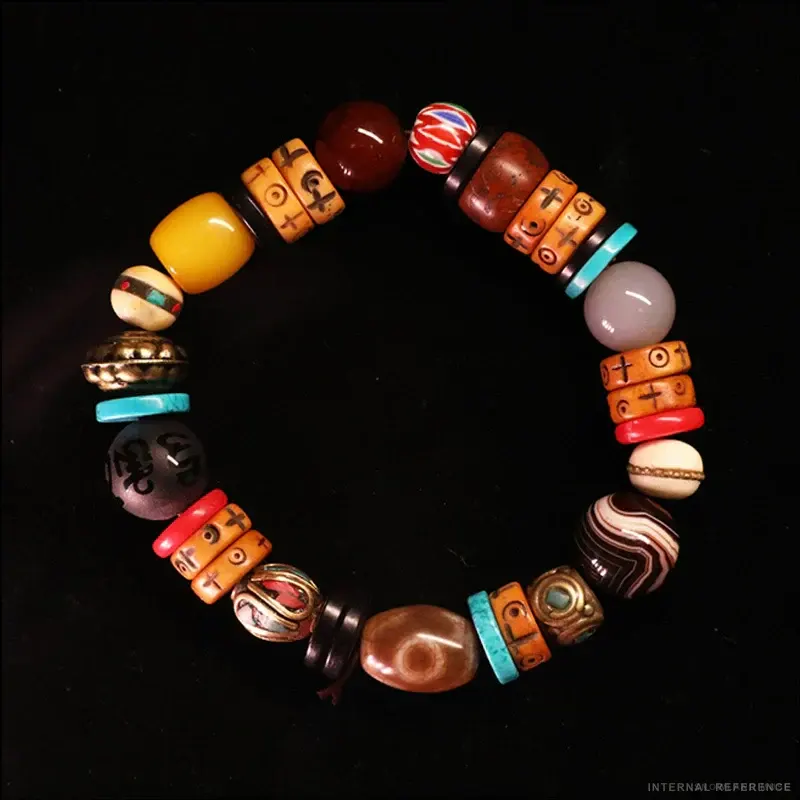
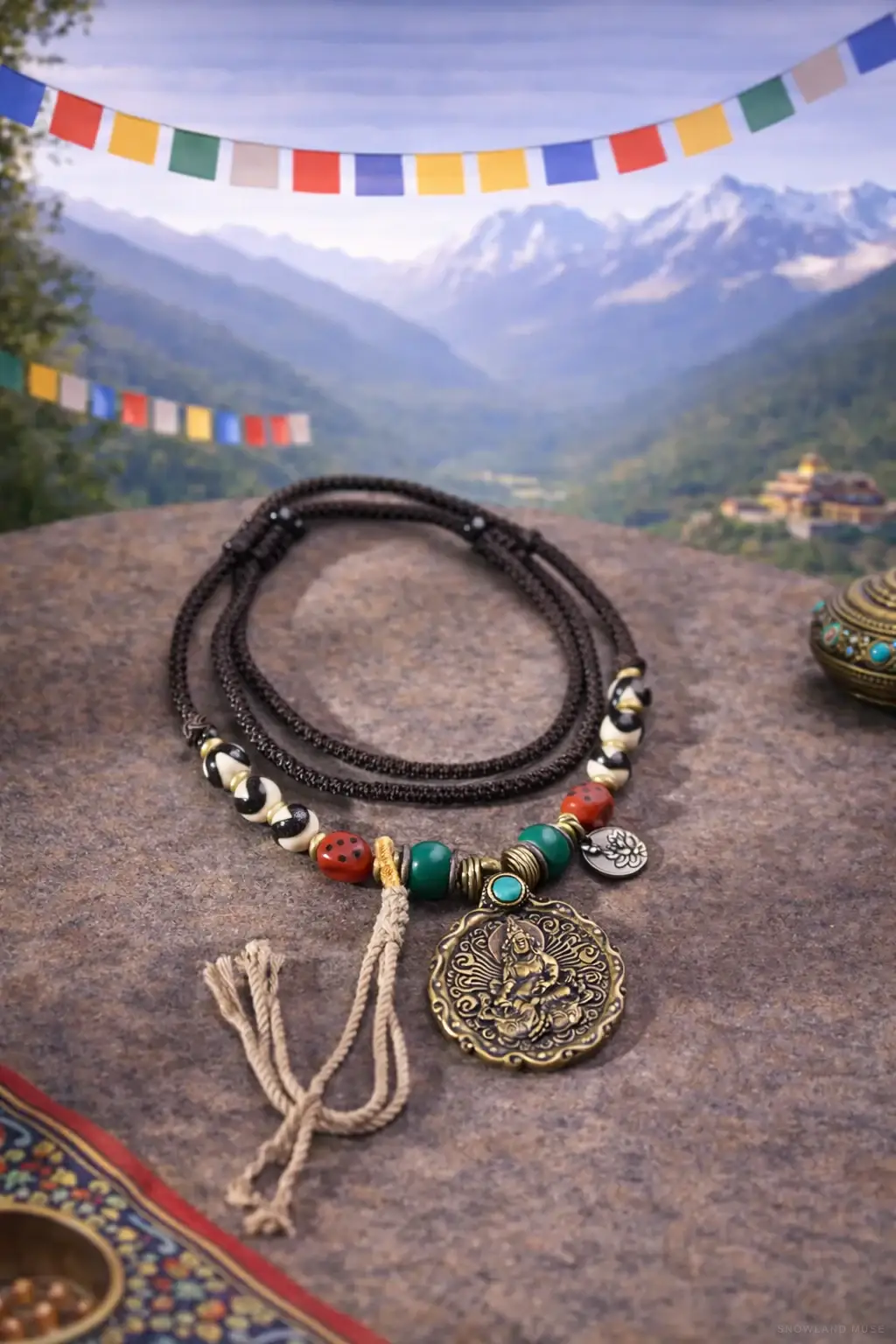
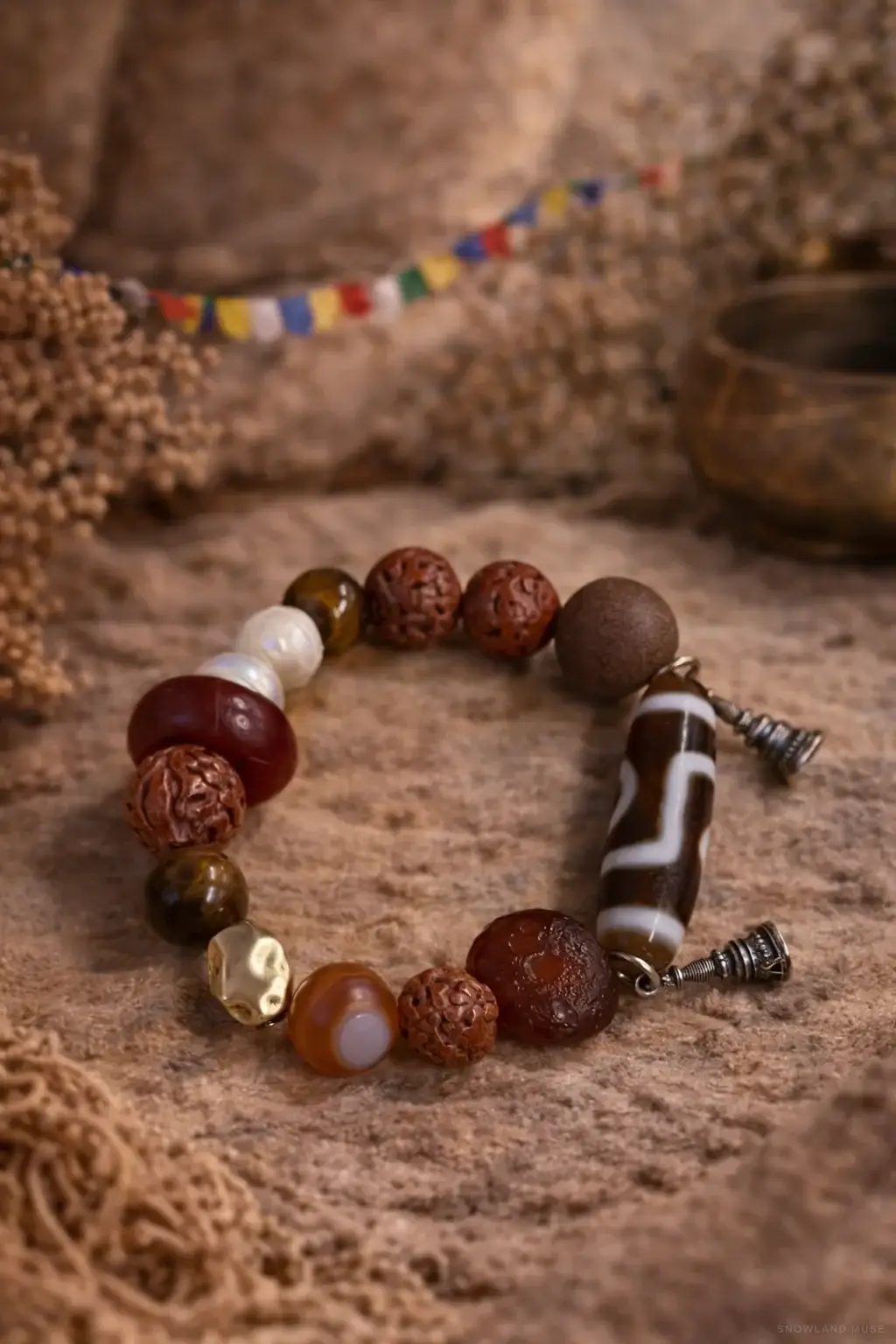
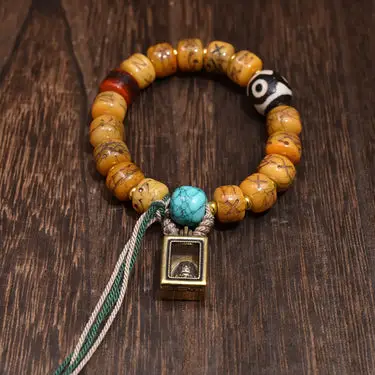
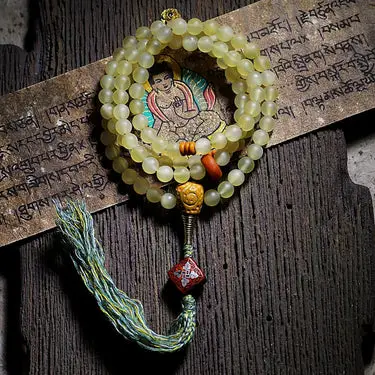
Its centre of gravity is the turquoise, a blue-to-green stone, usually opaque, often carrying a darker matrix web across the surface. And where the first is quiet, the agate is a banded, gently translucent stone whose layers catch light at the polished surface. Physically it is a strand that sits at the wrist. The piece belongs to the Dzi-style bead series, where the bead pattern leads the design and the companion materials support it. The Dzi-style motif appears as eye, stripe and wave patterns worked into the agate itself. These patterns belong to the dzi bead tradition, and the label describes the bead design only — not the age, origin or history of the piece. The Buddha motif is rendered as a seated figure in shallow relief. It is drawn from Buddhist visual tradition and gives the design a composed, symmetrical centre; its meaning sits with the wearer rather than in any promised outcome.
What follows is a plain description of each material, including how it changes. Turquoise — an opaque blue-green stone, with a darker matrix webbing that shifts piece to piece. Day to day, being soft and slightly porous, it prefers to be kept clear of hard contact. The agate is a banded stone that stays faintly translucent, so each layer picks up light differently. Against the skin, it takes daily knocks without dulling, though a thin edge can still chip against stone or metal. Inside the piece, the Dzi-style bead is an agate bead whose eye and stripe patterns sit in contrasting bands across the stone. Handled often, because the pattern is inside the stone rather than applied, it does not wear off with handling. The jade appears as a smooth, subtly translucent stone with a fine internal grain. Over months of wear, it is tough and forgiving in daily wear, and the surface takes a gentle sheen with handling. Copper — a warm red-brown metal that never glares back at you. In everyday use, its surface deepens in tone the longer it is worn, so the colour you receive keeps moving. The yak bone is an ivory-toned organic material, matte and slightly porous, with natural grain marks. Worn against fabric, it is light, warm to the touch and slightly absorbent, so it ages fastest where it meets skin.
Three wrist ranges are listed, spanning 6.75–8 in at the smallest and 9.5–10.5 in at the largest. Both options are made to the same visual proportions, so the choice is about fit rather than look. The protective reading of this piece is a wearer’s reminder, not a result it guarantees. Bead tone, matrix and grain will not repeat exactly from one piece to the next, and that is normal. The selected piece, its measurements and the preparation window are confirmed in writing before you pay.
Care
Keep it away from perfume, sunscreen, soap and household cleaners, none of which the stone tolerates well. Wipe it with a soft dry cloth and store it separately so the polish is not scratched by other jewellery. Care for it as you would a polished agate: keep it away from chemicals and impact, and wipe it dry after wear. Avoid impact at thin edges and keep it away from household chemicals; a soft dry cloth is enough. Wipe it dry after wear and store it away from damp air; polish only with a copper-safe cloth if you want the original brightness. Keep it dry, out of prolonged sun, and never soak it. Put it on last and take it off first, and keep it in its own pouch between wears.
A note on meaning
Symbols and materials may support reflection, memory or ritual. They are not medical treatment and do not guarantee wealth, protection, healing or any spiritual result.